
Key Takeaways
For centuries, cultures all over the world have created their own wedding traditions that communities still practice today. From the bride wearing red to shaving the groom, these unique traditions are full of meaning, heritage, and fun.
While you may be familiar with American wedding traditions—the bride wearing white, a couple exchanging rings, and vows that end in “I do”—there are endless unique traditions around the world that symbolize the union of two people in love. While some special ceremonies are especially important to couples that follow a religion, others are traditions passed down through small regional communities over generations. No matter where an engaged couple lives in the world, they can incorporate traditions particular to their heritage as a way to honor their roots.
Today, many celebrants structure their wedding their own way—blending their two cultures to create a wedding experience that reflects who they are and where they’ve come from. Whether it’s going without bridesmaids, or even rethinking the classic white wedding dress, below, discover 17 of the most unique wedding traditions from around the world.
In Germany, on the night before the wedding day, the couple can host a polterabend, a celebration where guests smash porcelain—usually in front of the bride’s home—to ensure good luck for the couple’s marriage. Following the fête, the couple cleans up the broken shards to ward off evil spirits, symbolizing their ability to face hardships together in their married life. Following the wedding, the newlyweds tread over a trail of fir branches that epitomize their fortunate and fertile future, and complete baumstamm sägen, a ritual where they join forces to saw a log in half. Much like the polterabend cleanup, this wedding custom represents the couple’s strength in unity.
Today, polterabend celebrations are reasonably common in rural German communities. However, since this fête often comes with heavy drinking similar to a bachelor or bachelorette party, many opt to host this celebration days or weeks in advance of the wedding to prevent too much of a hangover on the big day.
The money dance is a wedding tradition found in many cultures, and manifests differently depending on the region. At Mexican weddings, everyone who dances with the bride or groom is expected to pin money on their outfit, a celebratory gesture that contributes to the newlyweds’ honeymoon and other wedding expenses. Another version of this tradition is done in Nigeria, where the couple will be showered with money while they dance. Collectors will then put all their money in bags for the couple to take after the celebration. In a recent Vogue wedding, couple Juju Smith-Schuster and Laura Kruk did a Taualuga dance—a Samoan take on this tradition.
In a traditional Greek wedding, the koumbaro, or best man, is tasked with the most important groomsman role—groomsman, quite literally. It involves carrying out a wet shave for the groom on the morning of the ceremony. This wedding tradition is a testament to their shared trust that goes beyond surface-level friendship. In modern times, this tradition is commonly practiced in Greece, as well as by people of Greek descent around the world.
At a Hungarian wedding, you might find the bride wearing red later in the evening. According to tradition, the bride will change into a new dress at midnight called a menyecske ruha, known as the “new wife dress.” It is meant to symbolize that the bride is now officially married. Model Barbara Palvin showed off the Hungarian custom at her wedding to actor Dylan Sprouse.
A fun game that is played during Indian wedding celebrations is a rice-in-the-rice game, or angothi khela. During this game, the couple will search for a ring hidden within a bowl full of rice. The first person who finds the ring has bragging rights over the other spouse and will “rule” their home in the future. Bride Meeka Hossain infused this tradition from her culture into her blended wedding in Los Angeles.
The end of a wedding is often bittersweet—especially an Italian wedding, where the newlyweds often gift their guests with small party favors, in the form of bomboniere. Given as a gesture of gratitude, Italian bomboniere are confetti made of five sugared almonds that can be wrapped in a tulle bag or boxes adorned with ribbons. The almonds symbolize good luck and the shared love of family life. Many couples who travel to Italy for a destination wedding choose to include this tradition in their celebrations as well.
During a Persian wedding ceremony, known as the Aghd, a couple will sit in front of a table, or Sofreh, full of meaningful items. These represent the shared journey of life that the couple will embark upon. Traditional items on the table will include two candlesticks signifying light, a mirror representing eternity, nuts and eggs for fertility, and coins for prosperity. These beautiful displays have been seen in many ceremony setups featured in Vogue.
At a Catholic Mexican wedding, you can commonly see a unity ceremony with a lasso, or lazo, take place. During the lasso ceremony, the couple’s hands are bound together with either a rope or rosary to symbolize their commitment to each other and the idea that their lives are now intertwined. This tradition is quite prevalent in many Filipino and Latino communities. Irish weddings also have a similar handfasting ceremony, which lends to the phrase “tying the knot.”
In Chinese culture, a couple might participate in a tea ceremony with their families. This event involves the couple ceremoniously serving tea to their parents, grandparents, and other members of their extended family. The couple will usually receive gifts and well wishes in exchange for this show of reverence. It is usually hosted ahead of the wedding ceremony and can often be paired with a rehearsal dinner. We love the traditional attire and custom, embroidered pieces often incorporated into these events. Vogue bride Ann Liu had two bespoke looks made for her tea ceremony in Greece.
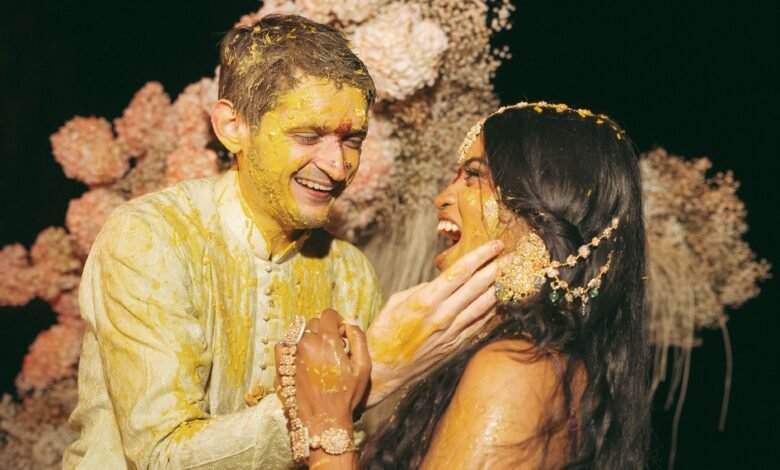
A few days before an Indian wedding ceremony, the bride and groom are joined by their closest family and friends for a pre-wedding ritual called the haldi. During the ceremony, family and friends apply a turmeric paste (named haldi, from which the name of the ritual derives) on the bride and groom as music plays and dancing takes place. Not only is it supposed to ward away evil spirits from the couple, but it also has purifying beauty benefits for the skin. The haldi used to only be done with the bride and her close female circle, but many modern couples choose to make it a joint event. One recent Vogue bride and groom chose to do the ceremony seaside so they could rinse off in the ocean afterward.
In Peruvian wedding receptions, the wedding cake is made up of several layers that are attached to ribbons tethered to charms, while one of the charms is a faux wedding ring. The “cake pull” tradition, known as the Cintas de la Torta, invites all single women to grab a ribbon. The lucky one who pulls out the fake ring is destined to be the next in line to say “I do.” It adds an element of suspense that makes it a fun departure from the standard bouquet throw. This tradition is also practiced by some communities in the American South.
Moroccan pre-wedding rituals typically include the traditional hammam, where the bride-to-be and the women in her inner circle indulge in a spa day of massages, exfoliations, clay masks, perfume prep, and waxing—every beauty treatment a bride might desire to feel her best for her special moment. A day or two before the wedding celebration comes the henna party, a North African custom observed in both Muslim and Jewish weddings, and typically hosted in the bride’s family home. Attendees greet and snap pictures with the couple, mingle, and dance, all while a henna tattoo artist adorns the bride’s hands and feet for good luck. The best part? Everyone is encouraged to get tattooed and revel in some shared fortune.
Wedding ceremonies in traditional Shinto culture can include a ritual known as San-san-kudo, which translates to “three-three-nine times.” During this ceremony, the bride and groom take three sips from three different sizes of sake cups, symbolizing the blending of families, the couple’s bond, and their individual lives. The number nine is considered an auspicious number in Japanese culture, making this tradition a particularly meaningful part of the wedding celebration. At this Vogue wedding in Japan, the newlyweds broke into a 36-liter sake barrel at their reception ahead of the ritual.
The paebaek is an important moment in a Korean wedding ceremony. While this moment was traditionally private, many couples now include the ceremony as part of a wedding cocktail hour for their guests to see. Both parents of the couple will sit at a low table filled with food. The couple will enter, bow, and pour tea. In exchange, the parents will offer blessings and monetary gifts. The couple will then bow and sit down. The parents will then throw dates and chestnuts as the couple attempts to catch them in a floral-embroidered white cloth. The dates and chestnuts symbolize children they will have in their future. At the end, the groom will give the bride a piggyback ride around the table. This tradition is a very common sight at Korean nuptials. Actress Arden Cho recently performed the ceremony with her now-husband Christopher Lee at their Italian wedding.
One tradition at a Danish wedding? When the bride out of the room, other women can seize the moment to give the groom a friendly peck on the cheek. According to this Scandinavian tradition, the bride can also have guests give her a kiss when the groom is away. Don’t worry though… the married couple is still encouraged to kiss each other throughout the night, too. Guests will clatter their knives and forks on the table throughout dinner to prompt the newlyweds to kiss.
While a smiling couple is a frequent sight in Western weddings, it’s the opposite in Congo. To show they are serious about their upcoming marriage and commitment, Congolese couples are not supposed to smile throughout their wedding day, from the ceremony to the reception. Many traditional families in the Congo still follow this practice.
Keep your eyes on the bride at a wedding reception in Ireland. When an Irish bride is on the dance floor, tradition calls for her to dance with one foot always on the floor. If both feet lift off, folklore warns that evil fairies will come and carry her away. This Irish wedding tradition isn’t as commonly followed today, but those who get married in the country might reconsider doing a big lift during their first dance.
Source: www.vogue.com